Fire Line & Water Main Installation
We install underground fire service lines and water mains on private property, and we work as the underground partner for fire sprinkler contractors: the connection at the water purveyor's vault or main, the backflow assembly, hydrants, meters and the line to your riser, tested, flushed, certified and repaved. Fire sprinklers and plumbing inside the building are by others.

Who it's for
- Fire sprinkler contractors who need an underground partner to build, test and certify the fire service up to their riser
- Developers and owners of commercial, multifamily, industrial and hillside residential projects whose permit calls for a new fire service, a hydrant or a larger water service
- General contractors who need the underground fire and water package built, tested and signed off without holding up the building
- Engineers and architects who want the contractor who builds the line involved before the utility plan is final
- Property managers with a leaking, broken or undersized fire line or water main
How the work goes
- Send us the plans. The civil or fire service plan, the purveyor's requirements and any fire department conditions. We can budget from early plans; a firm price needs the approved set.
- Line up the purveyor. With LADWP, the owner files the Service Advisory Request and pays LADWP's fees directly. LADWP usually builds the tap, the service lateral and the vault, and lead times run months, so we schedule the on-site work around it. With other purveyors that allow a private contractor to tap the main, we make the hot tap ourselves.
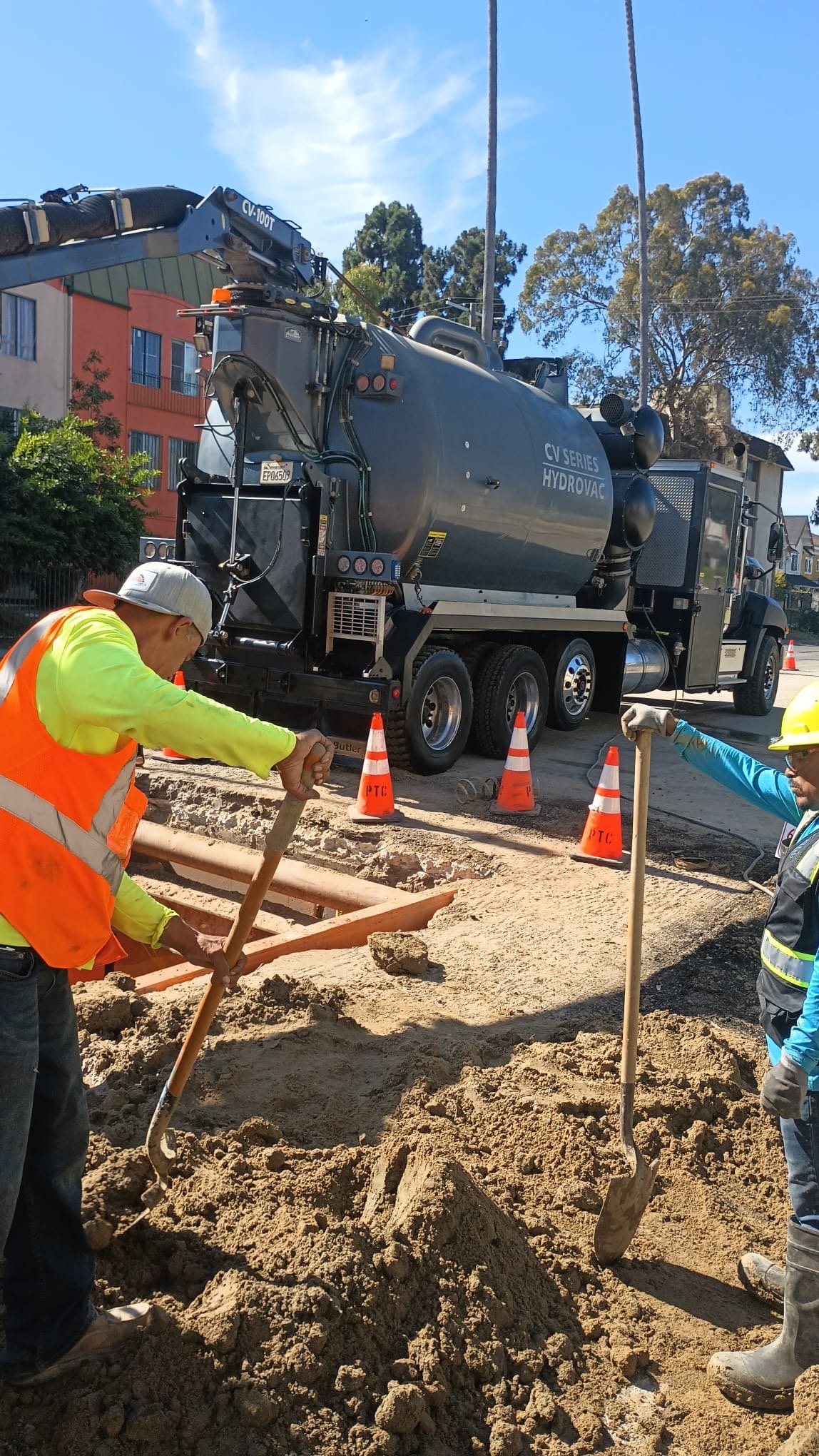
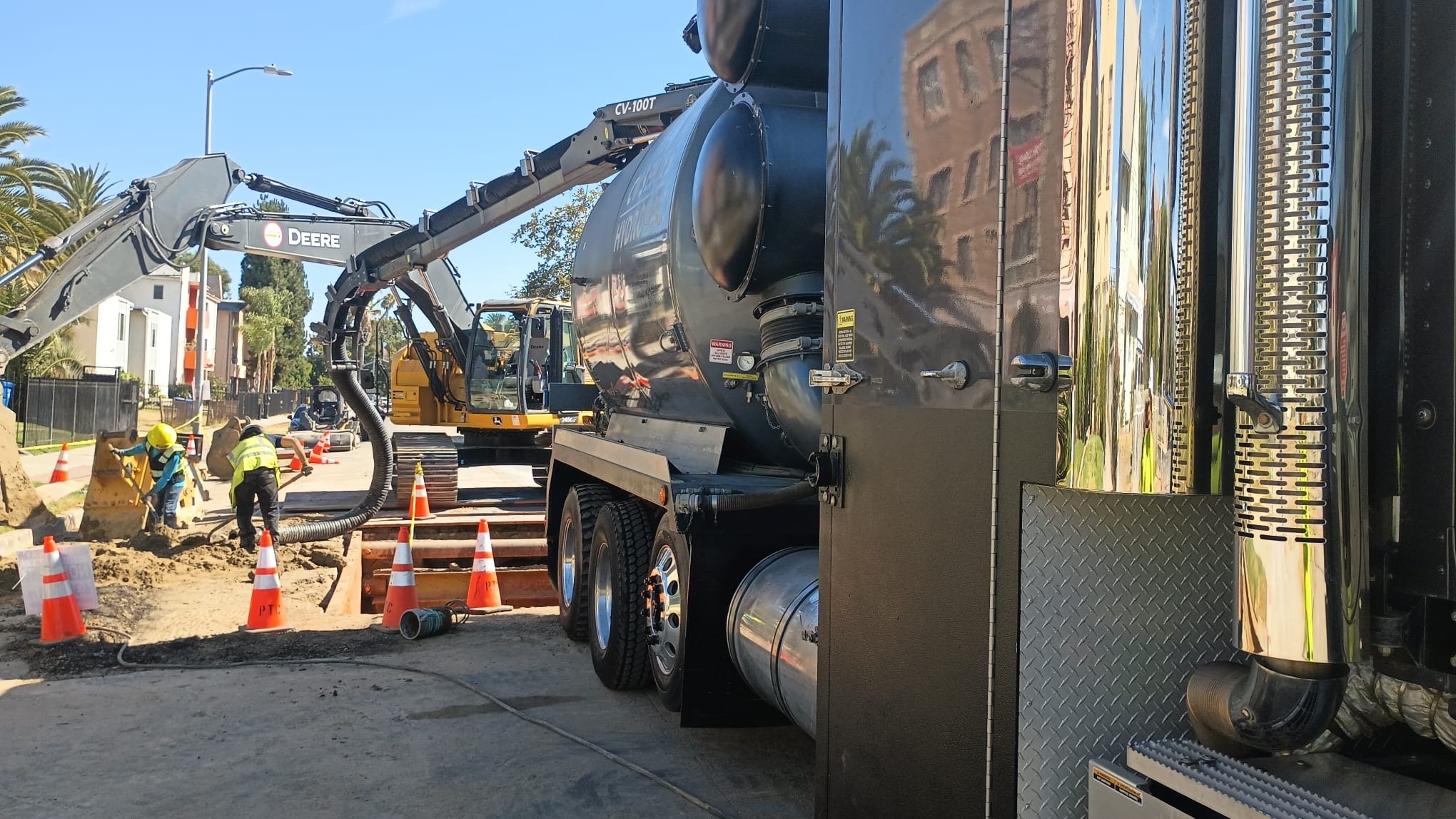
- Locate and pothole. We locate existing lines and expose crossings with our own hydrovac before the trench is cut.
- Build the line. Trench under our Cal/OSHA annual permit, then install the pipe, fittings, thrust blocks or restraints, the backflow assembly, valves, the fire department connection, on-site hydrants and the meter where the purveyor allows, up to the building's point of connection.
- Test and flush. Hydrostatic pressure test and flushing to the agency's requirements, with the inspector present where they require it, before anything is covered.
- Backfill and restore. Compacted backfill, or slurry where required, then the asphalt, concrete or landscape put back to match, including a T-cut repave in the street where the agency requires one.
- Hand off. The sprinkler contractor ties in at the riser, and the line goes into service.
What drives the cost
- Pipe size, length and depth, and what is already in the ground
- The backflow assembly the purveyor requires, and the number of hydrants
- Whether the tap is made by the purveyor or by us
- Surface to cut and restore: lawn, concrete, asphalt or a street with traffic control
- Slurry backfill or a T-cut repave where the agency requires it
- Inspection and testing schedule
- Permit, purveyor and agency fees, which the owner pays directly
What we do differently
One Class A contractor from the main to the building, through testing and repaving.
From the main to the building, one contractor
A fire service usually passes through several hands: the water purveyor, a pipe crew, a backflow installer, a paving company and the sprinkler contractor. We carry everything from the purveyor's connection to the building's point of connection, then test it, flush it and put the surface back. One licensed crew, one point of contact, and nothing left open waiting for the next trade.
What we build
- Fire service lines. The underground fire main from the purveyor's vault or connection to the riser at the building, with fittings, thrust blocks or restrained joints and valves.
- Backflow assemblies. Double check detector assemblies, reduced pressure assemblies and fire department connections, set to the purveyor's standard.
- Fire hydrants. Private on-site hydrants, and hydrants a public works permit requires as a condition of your project.
- Hot taps and connections. A live tap on the city main where the purveyor allows a private contractor to make it, or a tie-in at the vault where the purveyor builds the connection.
- Meters and water mains. Meter installation where the purveyor allows it, and domestic or combined water mains across the property to the building.
- Repairs and relocations. Lines moved out of the way of new construction, and existing lines repaired. Leaking or broken? See fire line and fire main repair. Finding a line first? See utility locating and potholing.
Where our scope starts and stops
Our work runs from the purveyor's connection to the building's point of connection, usually the riser flange. Fire sprinklers, standpipes and everything inside or above the building belong to the fire sprinkler contractor. Plumbing inside the building belongs to the plumber. Design stays with your engineer: we build to the approved plans, and where a field change is needed, the engineer and the agency approve it first.
For fire sprinkler contractors: your underground partner
On most projects the underground fire service sits on the civil drawings and shows as "by others" on yours. We are that other: a Class A General Engineering contractor, a license California's Division of the State Architect accepts for the full underground portion of a fire service. You keep your crews on the riser and overhead, and we bring the water to you, tested and ready to tie in.
Who does what
- We build: the connection at the water purveyor's vault or main, the backflow assembly, valves, fire department connection piping, private hydrants, the underground pipe with thrust blocks or restraint, backfill and surface restoration.
- We test: the underground hydrostatic test and flush, with the fire authority's inspections booked and attended.
- We hand you: the riser stub or flanged spool at the termination point on the approved plans, capped and protected.
- You build: the riser, alarm and control valves, overhead piping, heads, the overhead design and permit, and the system test.
What you get at handoff
- Contractor's Material and Test Certificate for Underground Piping, signed
- Hydrostatic test record, at the pressure and duration the fire authority sets
- Flush record, completed before your tie-in
- As-built underground sketch with valve, thrust block and stub locations
- License copy for your prequalification file
We work private projects across Los Angeles, Orange and Ventura counties. Send the civil and fire service sheets and your schedule, and we'll price the underground as its own scope.
How the LADWP fire service process works
For a new or larger fire service in the City of Los Angeles, the owner files a Service Advisory Request with LADWP, then provides the plot plan and the building permit number and pays LADWP's fees. LADWP holds a job-site meeting to set the service location and vault grade. LADWP then usually builds the tap on its main, the service lateral and the vault, and pulls its own street permit. LADWP has quoted roughly 90 days from payment for services 3 inches and smaller and about 120 days for 4 inches and larger, so the on-site line is best scheduled around that date, not after it. Once the private side is built, the service is put "on for test" before permanent service is turned on.
Other purveyors, such as Cal Water, Golden State Water, Los Angeles County Waterworks and city water departments, have their own process. Some let a licensed private contractor make the tap and set the meter. We work to whichever purveyor serves the property.
Backflow: what the purveyor will ask for
LADWP's Rule 16-D requires at least a double check assembly on every dedicated fire service, and a reduced pressure assembly in higher-risk cases such as an auxiliary water supply. The assembly is the owner's, on private property, and a certified tester has to test it every year. We install the assembly; the annual test is done by a certified backflow tester.
Testing, flushing and inspection
Underground fire mains are pressure tested before they are covered, typically at 200 psi, or 50 psi above the working pressure if that is higher, held for two hours under NFPA 24. The line is flushed at high velocity to clear debris before it is connected to the sprinkler system. The fire authority or building department inspects and, where it requires, witnesses the test. Nothing is backfilled until it signs off.
Put back to match
We saw-cut clean openings, backfill and compact, or pour slurry where the agency requires it, then restore the asphalt, concrete, curb or landscape. In the street we restore to the agency's standard, including a T-cut repave where it is required. The goal is a site that looks like we were never there.
Licensed for underground fire service
J.F. Prieto Engineering Construction, Inc., Lic. #525452, Class A General Engineering, Class B General Building and HAZ. California's Division of the State Architect recognizes Class A General Engineering contractors, along with C-16 and C-34, for the underground portion of a fire service; each building department and fire authority confirms what it accepts on your project. We hold a Cal/OSHA annual trench and excavation permit, and every excavation is run by an OSHA-trained competent person. Private projects across Los Angeles, Orange and Ventura counties, from our office at 5180 Alhambra Ave., Los Angeles.
Common questions
Who installs the fire line from the LADWP vault to the building?
LADWP usually builds the tap on its main, the service lateral and the vault. From the vault to the building's point of connection, the owner's contractor builds the line, the backflow assembly and any on-site hydrants. We do that private-side work, then test it, flush it and restore the surface.
How long does an LADWP fire service take?
LADWP has quoted roughly 90 days from payment for services 3 inches and smaller and about 120 days for 4 inches and larger, after the Service Advisory Request is processed. We schedule the on-site line so it is built and ready when LADWP finishes its part.
Can a Class A contractor install an underground fire service?
Yes, in general. California's Division of the State Architect recognizes Class A General Engineering contractors, along with C-16 and C-34, for the underground portion of a fire service. Each building department and fire authority confirms what it accepts on a given project, so we check that at the start.
Where does your work stop and the sprinkler contractor's start?
We build from the purveyor's connection to the building's point of connection, usually the riser flange. Fire sprinklers, standpipes and everything inside or above the building are the fire sprinkler contractor's scope.
Do I need a double check or a reduced pressure backflow assembly?
LADWP's Rule 16-D requires at least a double check assembly on every dedicated fire service. A reduced pressure assembly is required in higher-risk cases, such as an auxiliary water supply. The purveyor's review sets which one your project needs, and the assembly has to be tested every year by a certified tester.
What pressure test does an underground fire line have to pass?
Under NFPA 24, an underground fire main is typically tested at 200 psi, or 50 psi above the working pressure if that is higher, for two hours, before it is covered. The line is also flushed at high velocity to clear debris. The fire authority or building department inspects and may witness the test.
Who decides whether my project needs a fire hydrant?
The fire department sets hydrant locations and the fire flow your project needs, usually as a condition of the permit. We install private on-site hydrants and hydrants a public works permit requires for your project.
Do you make hot taps on the water main?
Yes, where the water purveyor allows a private contractor to tap its main. A hot tap connects a new service to a live main without shutting it down. Where the purveyor builds its own connection, as LADWP usually does, we tie in at its vault.
Who repaves the street or driveway after a fire line goes in?
We do. We backfill and compact, or use slurry where the agency requires it, then restore the asphalt, concrete, curb or landscape. In the street that means the agency's standard, including a T-cut repave where required.
Can you repair a leaking or broken fire line?
Yes. We locate and expose the line, repair or replace the damaged section, test it and restore the surface. Larger replacements get a written proposal first.
From the field
Ready to talk about your project?
Send us the details and we will follow up with next steps, or call us directly.