
Septic Backing Up? Pits, Roots and Repair Time, Answered
When sewage comes up in the yard, pumping comes first, many times the same day. The usual cause is a seepage pit that can't absorb water as fast as the house uses it, clogged by biomat. We fix in phases while you live in the home, and a pit can't simply be replaced without a permit and testing.
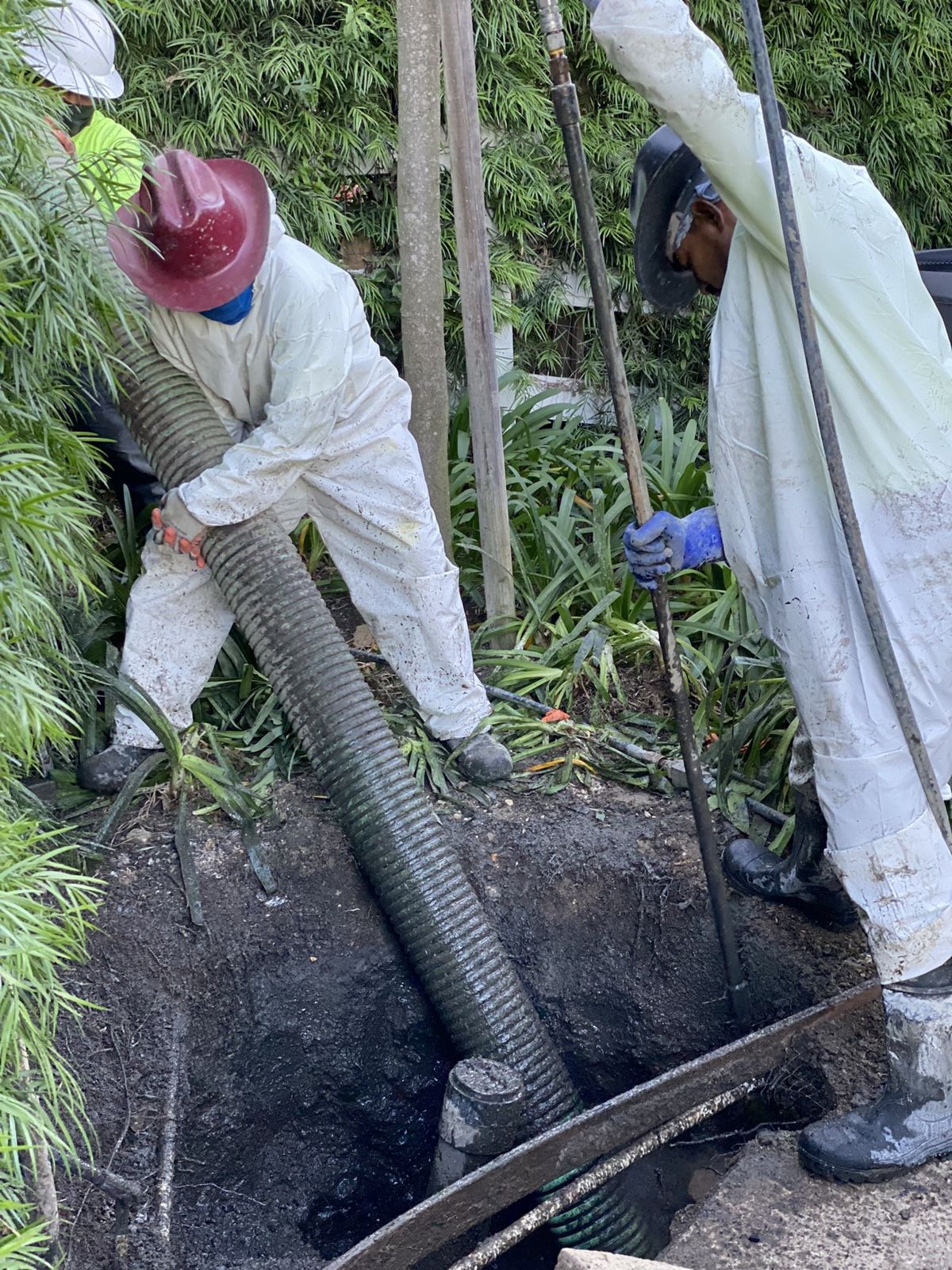
When a septic system starts backing up, the questions come fast. Can you come today? Can't you just replace the pit? Why do the roots keep coming back? How long will we be without plumbing? Here is how we answer them in the field.
Sewage is coming up in the yard and the toilets won't flush. What happens first?
The first step is pumping. We send a service agreement for pumping right away, and many times we can pump the same day, including after hours.
Then we look for the cause. In order of how often we see them:
- The seepage pit has failed. It can no longer absorb water faster than the house uses it.
- The second side of the tank hasn't been pumped. Sometimes it isn't accessible, so it never gets serviced.
- A problem in the line. Between the tank and the distribution box, or between the tank and the pit.
Whose fault is it that my system keeps struggling?
There are many reasons a system fails or keeps overflowing. Many times, what we find is biomat. Most septic systems don't fail because something broke. They fail because a slimy layer called the biomat builds up where there's no oxygen and clogs the soil. In many pits the soil is completely clogged with it.
We always check for a water leak too. Even a small leak can push water levels high in an already aging system.
One of the best ways to remediate is to let a field or seepage pit dry out completely, by pumping it or clearing it of standing water, as long as the property has other pits or a drain field it can use in the meantime.
The bigger picture is that the septic industry is moving toward maintaining aerobic bacteria generation systems, not just pumping. These systems fight the biomat through a biological process: a colony installed in the tank generates aerobic bacteria that eat the biomat and the organic waste inside the tank. Pumping every few years removes solid waste, sludge and scum, but it does not reduce the biomat. We have been installing aerobic bacteria generation systems for about 20 years.
Think about the total cost of the system, not just the next pumping
The cost of a septic system isn't only pumping and maintenance. It is the total cost of the system over time, and that includes replacement. Replacement is a big cost driver, especially where advanced treatment systems are required, near blue lines, streams and waterways, and with setbacks from property lines and structures.
A system that has an aerobic bacteria generation unit or an aerobic treatment unit from the beginning counteracts the biomat, and the overall cost of owning it, replacement included, would drop significantly, with yearly maintenance in place of periodic pumping.
There is a pattern in concrete tanks too. Concrete tanks without an aerobic process tend to deteriorate badly, especially across the entire top of the tank, because the gases from an anaerobic system keep eating the concrete. Compare aerobic and anaerobic tanks and the difference shows.
How we fix a struggling pit while you live in the home
If someone is living in the home, we go in phases to keep costs as low as possible, and we step up only as far as needed:
- System working correctly: a bacteria generation unit in the tank.
- Starting to have issues: one unit in the tank and another in the pit.
- Still having issues: for us that means continuous pumping, because the bacteria being produced isn't eating the biomat faster than it forms or faster than the usage. Then we add liquid dosing: a high first dose in the tank as a shock treatment, then high dosing that tapers off to fight the biomat on an accelerated schedule.
- Then, and only then: physical remediation of the pit.
A bacteria generation unit is designed to reduce, and in many cases eliminate, the need for pumping. It has limits: it can't digest things that aren't safe for a septic system, it can't fix a pit that has already failed, and it stops working if the air pump is unplugged.
What is soil replacement around a pit?
With soil replacement, we remove a significant portion of the soil at the upper section of the pit, by hand, with an excavator, with hydro-excavation, or a mix. We do it when the biomat has grown so high on the pit that water can no longer percolate out at all. That is a total failure, and it comes down to a simple math equation: usage is greater than percolation.
We typically limit this recommendation to real estate transactions, where the system needs to be certified and usable from the day someone moves in.
Can't you just replace the pit?
There is no such thing as just replacing the pit, with one exception: when the plans on file already designate an area for a replacement pit. Even then, we can't simply drill there. It still needs a permit, and it still needs a percolation test, a Qualified Professional's report, or both.
An older system with no plans on file typically needs a feasibility study. That study usually calls for a new system, many times an advanced treatment system, along with plans and submittals. It is a much bigger process, because a new pit location has to be drilled and tested. Licensed professionals design that work; we build it.
Roots keep coming back in my septic. Why?
Roots usually come from an unsealed tank or leaking plumbing connections. The places we find them getting in:
- The lid joint. Many tanks have a lid that was placed or poured separately, and that joint is usually where roots get into the tank.
- The T-baffle connection. The tank settles or moves, and the pipe breaks right at the connection outside the inlet or outlet.
- Pipe joints. Many are old or were never glued, or they are clay connections, which are unsealed as well.
The fix for the tank is to reseal it. We wash it out and clean it thoroughly, then waterproof it from the inside at all the joints and at the upper section, which is typically the part that has deteriorated.
How long will we be without plumbing during the repair?
It depends on the repair. We usually try to do all the work within business hours and have the system back up and running the same day, even if we have to disconnect it again the next business day for more work.
- Work downline from the tank, with the tank pumped: the tank typically has enough storage that we just ask you to go easy on water.
- Tank restoration or lid repair: no water use at all during the business hours we are there.
Keep reading
For the full story on the biomat, read Why Most LA Septic Systems Fail: The Biomat, Not a Broken Part. For warning signs, see 7 Signs Your Seepage Pit Is Failing, and What Can Fix It Without Starting Over. If a new system may be on the table, start with What Is a Septic Feasibility Report in LA County, and Do You Need One?, and see our ORCA Septic Restoration service.
Frequently asked questions
Can you pump today?
Many times, yes, including after hours. We send a pumping service agreement first, then schedule the truck.
Can a failed pit just be replaced?
Only where the plans on file already show a replacement area, and even then it needs a permit and a percolation test or a Qualified Professional's report. Without plans, expect a feasibility study.
Does pumping fix the biomat?
No. Pumping removes solids, sludge and scum. Aerobic bacteria are the way to fight the biomat.
Will we lose water overnight?
We usually try to have the system working again the same day, even if more work follows the next business day.
Where we fit
JF Prieto Engineering Construction, Inc. is a family-run Los Angeles contractor, in business since 1978, that pumps, repairs, restores and certifies septic systems across LA County. If your system is backing up, call us: (800) 606-3880.
CA Lic. #525452 · Class A + B + Haz
Sources
- JF Prieto Engineering Construction, Inc field practice: owner interview answers recorded November 2026.