
Rainy Season in the Burn Areas: Pacific Palisades, Malibu, Altadena and Eaton Canyon
Homes in and below the Palisades, Franklin and Eaton fire burn scars face a higher risk of mud and debris flows for several years after a fire. Before each storm, clear drains and basins, steer water with sandbags, protect open rebuild lots with erosion control, and follow evacuation warnings. LA County Public Works takes mud and debris flow concerns at 1-800-933-0930.
Why these neighborhoods are still at risk
Los Angeles County warns that mud and debris flow risk is higher for any area in or downstream from a burn scar less than five years old. The Palisades and Eaton fires of January 2025 and the Franklin Fire of December 2024 all fall in that window. The State Geologist has said that as little as a fifth of an inch of rain in 15 minutes can trigger a debris flow on a fresh burn scar. A storm does not have to be long to be dangerous; it has to be intense.
Pacific Palisades
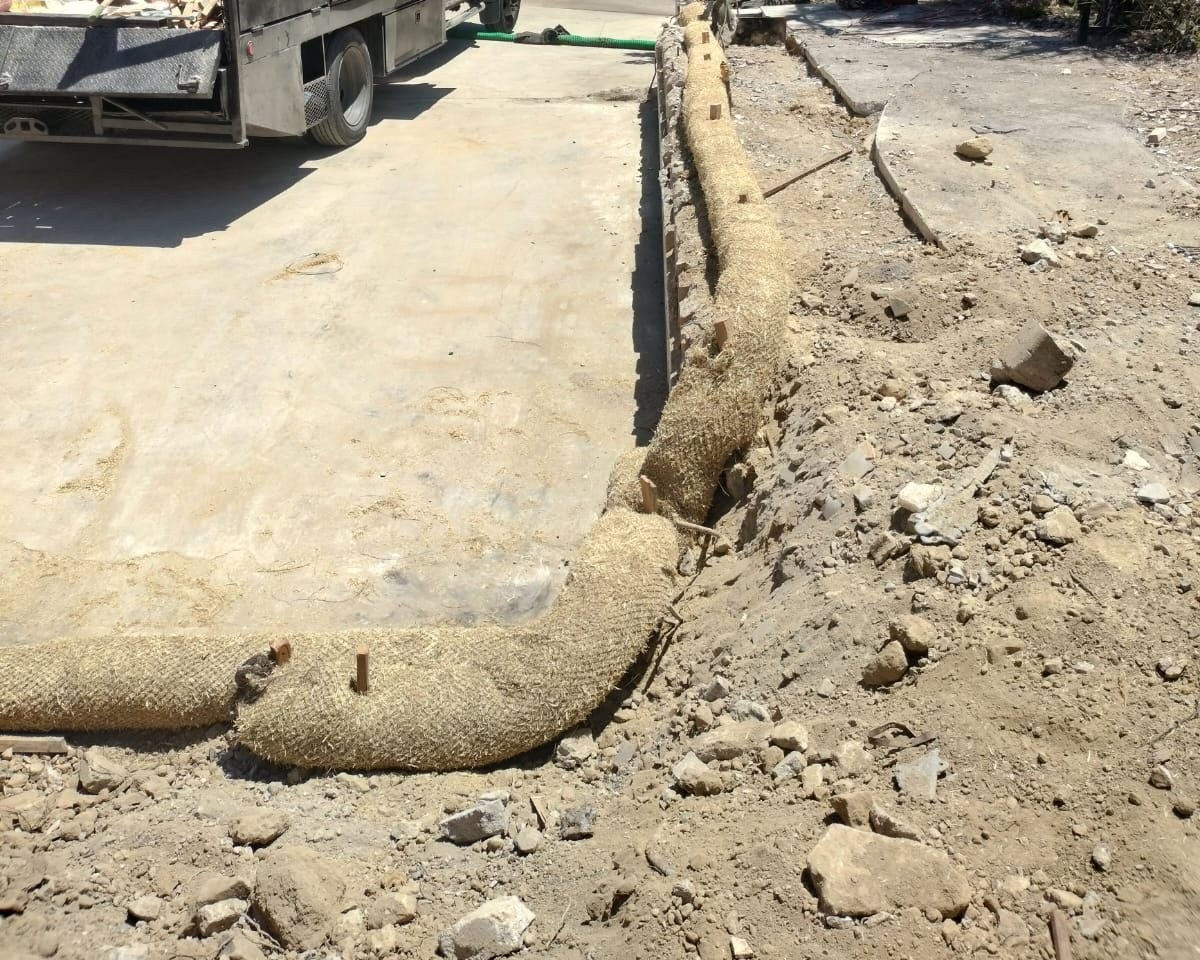
The Palisades Fire burned the steep canyons above the Palisades, Topanga and the eastern edge of Malibu. Many lots are still bare or under construction, which means more open soil and fewer plants to hold it. On rebuild lots, the County's Fire Debris Removal permits required erosion control to be installed and photographed before the permits could close. We did that work on Palisades lots in 2025, and the inspector's comments came back to the same points every time: perimeter bags or rolls, protected drains, and clear photos.

Malibu: the Franklin and Palisades burn areas
The Franklin Fire started near Malibu Canyon Road on December 9, 2024 and burned about 4,000 acres around Pepperdine and central Malibu. A month later the Palisades Fire burned into eastern Malibu. In February 2025 a debris flow on Big Rock Road swept a fire department vehicle into the ocean. Malibu homes also carry a risk most of the city does not: septic systems. Mud and ash can plug a septic tank or seepage pit, and the City of Malibu has told us that on fire-damaged properties the inlet side of the septic tank's lateral line should be capped to keep dirt and debris out. We have worked Malibu hillsides since the 2018 Woolsey Fire.
Altadena and Eaton Canyon
The Eaton Fire burned about 14,000 acres of the San Gabriel foothills above Altadena and Sierra Madre and destroyed thousands of homes. On February 13, 2025, a storm sent debris flows into Sierra Madre and mud across Altadena streets. County crews have cleared debris basins and placed K-rail, but streets below the foothills can still carry mud. This season we are working on drainage and sump pump systems for Altadena homes, and the same rule applies to every one of them: know where the water goes before the storm comes.

Before every storm in a burn area
- Sign up for alerts and follow evacuation warnings. Property can be repaired.
- Clear your drains, catch basins and curb outlets. Ash and silt fill them fast.
- Steer water with sandbags toward the street, never onto a neighbor. The County hands out sandbags in Altadena and Malibu before storms; check their sandbag page for current locations.
- Protect open rebuild lots with fiber rolls, covered stockpiles and inlet protection.
- Keep septic lids accessible, and on fire-damaged lots cap the inlet lateral where the City or County requires it.
- Photograph your property before the storm so you can show what changed after it.
- Line up a contractor now. After a big storm, every crew in town is booked.
Useful numbers
- Emergency or anyone trapped: 911.
- LA County Public Works, mud or debris flow concerns: 1-800-933-0930.
- LA County Public Works 24-hour dispatch for storm damage: 1-800-675-4357.
More from us: what the 2010, 2018 and 2025 storms taught us, and our drainage and earthwork and hauling services.
Mud on your property, or rain on the way? Call (800) 606-3880 or send us photos through the contact form. Family-run in Los Angeles since 1978. CA Lic. #525452 · Class A + B + Haz.
Sources
- JF Prieto field records and correspondence, 2018–2026.
- LA County: Storm Season Is Here (October 21, 2026)
- Santa Monica Daily Press: County outlines El Niño storm preparations
- LA County Public Works: Franklin Fire incident report
- PBS SoCal: How debris flows endanger LA's fire-ravaged communities
- LA County Public Works: storm preparation and 24-hour dispatch