Tank Full, Pit Dry: How to Read a Septic Inspection When You're Buying
Read the tank and the seepage pit together. A tank at its normal level with a dry pit is, for the most part, a good functioning system. A low or high tank may point to a leak or an overflow. A clean tank with an empty pit typically means it was pumped before the inspection, and that is when we suggest a 24-hour hydraulic test.
When you are buying a house on septic, the inspection report is full of small readings: how high the water sits in the tank, whether the seepage pit is dry, whether there is an aerator, whether the old pit is really a cesspool. Each one means something. Here is how we read them in the field, so you know what to ask before your contingency runs out.
Ask about the whole system, not one part
Buyers sometimes ask whether they should back out of a house because it has a seepage pit. That question looks at one piece. A septic system is the tank, the lines, the distribution box where there is one, and the seepage pits or leach lines, all working together. The useful question is how the whole system is doing, and what it would take to get it certified.
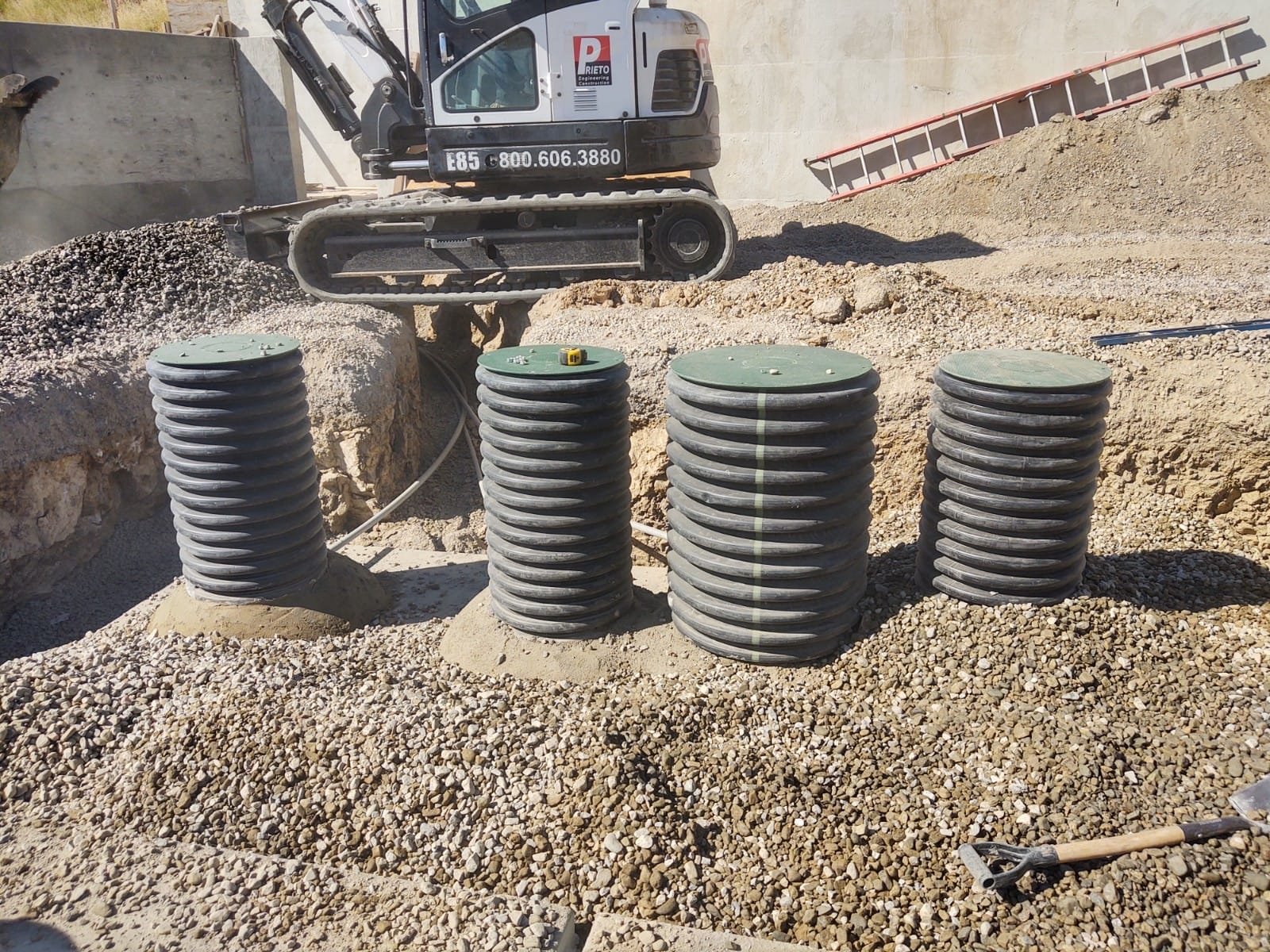
That is why a real inspection needs access to each part. The tank has to be serviceable, and we need to confirm there are no collapsed pipes and no roots that would cause a backup between the house, the tank and everything beyond it. When there is no access on one side of the tank, we often have to dig to the top of it. If the camera runs cleanly and every part can be reached from the surface, for example through larger-diameter risers where we can push the camera through the lines in either direction, digging down is not necessary.
What do the tank and pit levels tell you?
The water level in the tank and in the seepage pit tells us a lot about the system. Read together, they usually point one of four ways:
- Tank at its normal operating level, pit dry. For the most part, a good functioning system.
- Tank level low, pit dry. The tank may not be working correctly and may have a leak.
- Tank level high, pit dry. The tank may be overflowing somewhere else.
- Tank clean with little scum on top, pit empty. This typically means someone pumped before the inspection. That can mean the pit was backing up or overflowing and needs constant pumping.
Why we look closer at a freshly pumped system
Over the years, many sellers have tried to hide or not disclose an overflowing or failing seepage pit. One of the easiest ways is to pump everything, so the tank is empty of organic waste and the pit level is very low on inspection day.
Our job is to look closer. We look for signs of historically higher water levels, or dampness. When we see too many of those signs, or we can tell the system was pumped, we strongly suggest a hydraulic test. A 24-hour hydraulic test shows whether the water percolates or not. The test method is set for each property by the governing agency.
If you are the seller, please don't pump the tank before we inspect it. The standing levels are the evidence.
The seller says the aerator means the system is fine. Is that right?
Not on its own. When we find an aerator in a tank, the first things we check are whether sludge or scum is floating, and whether the tank has a foul smell or a neutral one. Aerobic bacteria generation systems usually take away the foul smell. Running well, they typically have a stale rosy-water smell.
Having one can be good. It can show that someone was proactive and maintained the system before something went wrong. It can also show that there was a failure that is being recovered. The aerator alone doesn't prove the system is fine.
The clearest way to know how the system is doing is to measure the total depth of the pit and the standing water in it, then work out how much volume is left above the waterline. Smaller pits make those numbers tighter, and that is when we recommend a 24-hour hydraulic test.
Can a house with a cesspool pass?
An existing cesspool is not automatically a failing system. What the agencies say depends on where the house is:
- City of Los Angeles. LADBS states that cesspools have not been permitted since the 1950s, so no new ones go in. Its bulletin also says an existing cesspool might be able to be converted to a seepage pit if a septic tank is installed, with a Qualified Professional's report on the site, the percolation and whether the upgraded system can handle any proposed additions.
- LA County. Public Health says existing systems need no action as long as they are not failing, and the County does not require a septic evaluation at sale. Buyers can make one a condition of their offer. Adding an ADU or a bedroom triggers the newer requirements. Converting a cesspool to a seepage pit without other changes requires a floor plan and an evaluation of the cesspool.
- Eaton Fire rebuilds. The County's recovery guidance says an existing cesspool may be used in a rebuild if it passes a Qualified Professional's percolation test, with no added flow and no added bedrooms, bathrooms or ADUs.
When a buyer asks us about a cesspool, our usual suggestion is that it would need a tank ahead of it, and possibly a new pit. The tank goes in first, so the cesspool can work as a seepage pit. That suggestion can be premature without real groundwork, though. Once the site is investigated and prepared, it may call for an advanced treatment system, not just a tank. The governing agency for that property has the final word, and a licensed professional designs any new system. We build it.
Where does that leave a buyer?
Whether to go forward depends on how the whole system is doing, not on the pit alone. The readings above are what tell you whether the system is working, whether something is being hidden, and what the next step is. Get the inspection done early in your contingency, ask what the tank and pit levels were, and ask whether a 24-hour hydraulic test is recommended.
For more on the two inspection levels, see Septic Inspections for Home Sales in LA County: What Buyers, Sellers and Agents Need. For what a failing pit looks like, see 7 Signs Your Seepage Pit Is Failing, and What Can Fix It Without Starting Over. Rebuilding in Altadena? Read Rebuilding After the Eaton Fire: Septic, Cesspool and Sewer Rules for Altadena.
Frequently asked questions
The tank is full but the pit is dry. Is that bad?
Usually not. A tank at its normal operating level with a dry pit is, for the most part, a good functioning system. A low tank or a high tank with a dry pit may point to a leak or an overflow somewhere else.
Why would a clean tank worry you?
A clean tank with little scum and an empty pit typically means it was pumped before we arrived. That can hide a pit that backs up. We look for signs of higher past water levels and may suggest a 24-hour hydraulic test.
Does an aerator in the tank mean the system passed?
No. It can mean good maintenance, or a system recovering from a failure. The pit depth and standing water tell us more.
Can a house with a cesspool pass?
New cesspools are not permitted, but an existing one is not automatically failing. The usual path to certify or expand is a tank ahead of it, with a Qualified Professional's evaluation, per the governing agency.
Where we fit
JF Prieto Engineering Construction, Inc. is a family-run Los Angeles contractor, in business since 1978, that inspects, exposes, repairs and certifies septic systems for home sales across LA County. If you are in escrow on a house with septic, call us early and tell us your dates: (800) 606-3880.
CA Lic. #525452 · Class A + B + Haz
Sources
- LADBS Information Bulletin P/BC 2026-027 (eff. 01-01-2026), Onsite Wastewater Treatment Systems: dbs.lacity.gov
- LA County Public Health, OWTS Requirements and Procedures (updated 6/16/2025): publichealth.lacounty.gov
- LA County Public Health, Local Agency Management Program FAQ: publichealth.lacounty.gov
- LA County Recovery, Septic Systems (rebuilding): recovery.lacounty.gov